 Isaac Codex
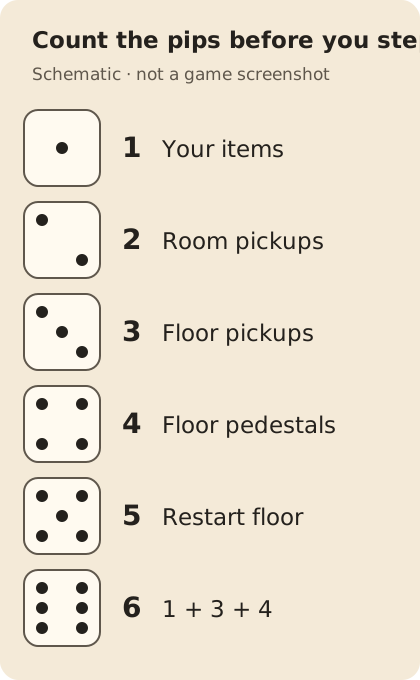
Before stepping on a Dice Room’s die, count the pips. In Repentance and Repentance+, 1 and 6 can change the items you are carrying; 5 restarts the floor. The other outcomes affect pickups or item pedestals. Each Dice Room triggers once.
Quick reference
| Pips | Main effect | What to consider first |
|---|---|---|
| 1 | Rerolls held active and passive items | Your existing build changes |
| 2 | Rerolls pickups in the current room | Does not broadly reroll the floor |
| 3 | Rerolls pickups and trinkets across the floor | Some room types are excluded |
| 4 | Rerolls item pedestals across the floor | Some room types are excluded |
| 5 | Rerolls and restarts the current floor | Finish anything you want to do first |
| 6 | Combines the 1-, 3-, and 4-pip effects | Held items and floor contents can change |
One pip: your build changes
This rerolls your active and passive items. Passive items draw from the item pool of the room where you originally picked them up. In co-op, the character who steps on the die is the one affected. Tainted Forgotten must land on it himself.
If your build already works, do not mistake this for rerolling loose pickups.
Two pips: the pickups in this room
Two pips rerolls pickups in the room, with an effect like the D20. It is the local option in this table. Do not confuse the room’s pickups with all your held items or the entire floor’s pedestals.
Three pips: pickups and trinkets across the floor
Three pips rerolls floor pickups and trinkets, including shop pickups. Devil Rooms, Angel Rooms, Black Markets, and Crawl Spaces are excluded. Shop pickups can become items; active items created in this way start without charge.
The scope is wider than two pips, but it still has boundaries. Check what you wanted to collect before activating it.
Four pips: item pedestals across the floor
Four pips rerolls item pedestals with an effect like The D6. Devil Rooms, Angel Rooms, Libraries, Black Markets, and Crawl Spaces are excluded.
An item still floating above its pedestal is uncollected. Four pips changes eligible pedestals; one pip changes items you have already taken.
Five pips: restart the floor
Five pips rerolls and restarts the current floor, like Forget Me Now. Complete anything you still want to do on this floor before stepping on it. It is not the same as rerolling a single room’s pickups.
Six pips: several rerolls together
Six pips combines the one-, three-, and four-pip effects, like the D100: held items, floor pickups, trinkets, and item pedestals can change. The exclusions from the three- and four-pip effects still apply. In co-op, held items are rerolled for every character.
If you only remember one distinction, remember this: one and six can replace your current build, and six affects every player’s held items in co-op.
Version and sources
This guide covers Repentance / Repentance+. It is condensed from the reviewed Dice Room reference, based on revision 266128 of Dice Room, The Binding of Isaac: Rebirth Wiki, fetched on 10 September 2026.
Attribution: Contributors to Dice Room, The Binding of Isaac: Rebirth Wiki (wiki.gg). Adapted, reorganized into a quick-reference table, and supplemented with clearly separated practical interpretations. This adapted article is available under CC BY-SA 4.0. Game artwork has separate ownership and is not covered by this text license.
Use the Dice Room reference in Isaac Codex when you want these distinctions beside your run.